2 ducks (or 4 duck breasts)
300 g raspberries
50 g sugar
2 teaspoons of white vinegar
200 ml duck stock (made from duck carcass or other poultry)
100 g cold butter
Salt and pepper
Remove the breasts and use the rest of the DUCK to make your duck stock. Put the raspberries and the sugar in a casserole, add a little water and cook for 15 minutes. Puree the raspberries and put them through a sieve.
Pour the vinegar into a saucepan and boil down over high heat until it’s almost evaporated, immediately pour in the raspberries and the duck stock and simmer about 20 minutes. Season with salt and pepper and stir in the cold butter. Do not allow it to boil anymore!
While the RASPBERRIES and the stock boil down, fry the duck breast in a little butter for three minutes on both sides (the skin side comes last). Then preserve in the oven at about 90° C.
If the raspberry sauce is ready, cut the breasts into slices, arrange on the plates with the sauce. Serve with spaetzle (thick Alsatian egg noodles), seasonal vegetables and an old, ripe SYRAH wine.
Despite its somehow exotic name, the origins of SYRAH are indeed to be found in the northern Rhone Valley. Originated from a cross breeding between WHITE MONDEUSE from Savoy and BLACK DUREZA from the Ardèche region, people preferred to maintain that its origins are more mysterious, referring to the Romans, the Syrians and the Persians, as well as to distant cities like Syracuse in Sicily or Shiraz in Iran . The fact is none of that. Despite its modest and more « down to earth » origins, SYRAH nowadays enjoys a growing popularity all over the world.
syrah
With some 185,000 hectares of vines planted, it’s now one of the ten most frequent grape varieties on our planet (although it remains far behind the mastodons CABERNET and MERLOT). A great success for this little girl FRENCH LADY, which feels as comfortable on the hills of L’HERMITAGE as in the vineyards of the MEDITERRANEAN, in CALIFORNIA or AUSTRALIA (which it’s commonly named SHIRAZ).
From a viticulture point of view, you could almost call her a DIVA. She wears her fine grape and small black berries more like jewelry than vulgar fruits and its fragile branches ask for support by careful trellising. Since the 1990s, a mysterious disease or rather a poorly understood phenomenon appeared, known as the « SYRAH DECLINE ». Cracks appear on the graft union between the plant and its rootstock, the foliage flushes and finally the plant dies ... Several years may pass between the onset of phenomena and final death of the plant, but no cure is known to date and reasons for decline have not yet been elucidated, even if « the clone" stays the main suspect for the moment (for each grape variety there are indeed several clones. Some clones of Syrah seem to be particularly susceptible to decline. They are now unsuitable for planting).
clones syrah
From a gustatory point of view SYRAH is capable of EVERYTHING! Known and recognized for the straight, fine and elegant wines it produces in the northern Rhone Valley, it is no less famous for her curves and the seductive delicacy she shows in a warmer climate. Pepper and licorice, cassis, raspberry and violet, truffle, cocoa ... depending on the ripeness of the grapes and the age of the wine, the aromatic range of SYRAH seems to stretch from one horizon to the other. Red and dark as sin, with fabulous tanins structures and sometimes able to live for decades - SYRAH belongs to the most beautiful grape varieties that man (and woman) have ever selected.
SYRAH likes to be panted in higher altitudes, as noticed YVES GIGONDAS in vineyards of VAISON-LA-ROMAINE and GIGONDAS, but it may also produce real miracles around the MEDITERRANEAN. And even NATHALIE, a girl real girl from the champagne region, confesses she has a weakness for wines from SAINT JOSEPH, as well as for PIERRE’S SYRAH that grows in the dry and stony terroir of LES ASPRES in the MINERVOIS.
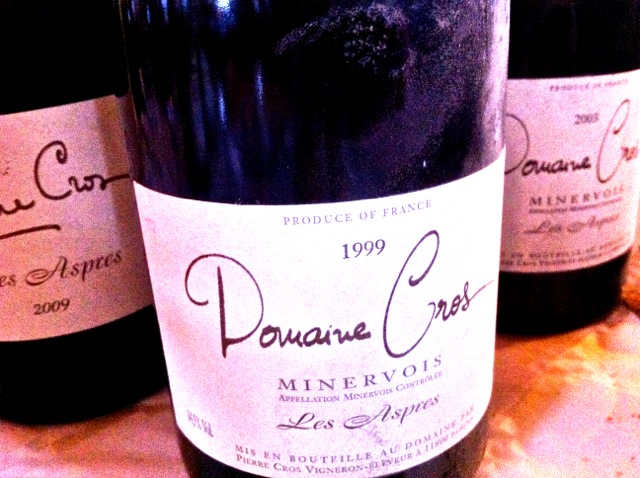
Power and Terroir – Les Aspres 2005 from Pierre Cros
Watch out, this wine immediately grapes you by the throat! It’s a wine that doesn’t know any compromises… He smokes, this wine, blond tobacco with the heavy perfume of sweet, oriental spices: Vanilla, cinnamon, star anise… Cooked fruit, macerated in alcohol, smooth and powerful at the time. A playful wine that spreads its fragrances like cards on your table. Not lacking elegance, he presents himself in a honest and self-confident way through his clear acidity a firm, tannic handshake. Nevertheless, he always speaks from the heart, with charming smells of liquorish and sandalwood.
You always should watch the serving temperature of this pure Syrah, like for every great red wine. 16°C seems to be perfect to calm its power and ardour. I savoured this wine with some black Bigorre porc and on a smooth Brie de Meaux cheese. Delicious! But this wine doesn’t necessarily have to go with food, it perfectly stands on its own. Drink now or leave it another couple of years in your cellar.
Les Aspres de Pierre Cros, a #Syrah with 8 top selections by the Guide Hachette
"Some will become jealous again... Three stars and the eighth “coup de cœur” ( the third in a row) for this great cuvee from Pierre Cros that bedazzled the jury again (in a blind tasting). The most envious will even get paler when they know that the remarkable “Vieilles Vignes 2011” did also very well during our “hunt for stars”.
“Les Aspres” are a masterpiece that makes us travel to eucalyptus and cedar woods, presenting warm and cooler fragrances in perfect harmony. On the palate, the first impression is of uncommon intensity and fullness, drenched with scents of ripe fruit and delicate vanilla. While the jurors described the wine as being creamy, soft and savoury, they also underlined its statuesque structure, carried by beautiful peppery tannins, that give an almost endless final to the wine…"
Guide Hachette 2014
The tradition of good taste at the Domaine Pierre Cros
Let’s not waste time on colour and other visual aspects of this wine. The truth that “wine is made for drinking and not for watching” applies to this cuvee ever since its creation. Mainly made of Carignan grapes, supported by equal parts of Syrah and Cinsault, as well as a smaller percentage of Grenache and Mourvèdre.
A real representative of southern France, that never tried to please at any price, but whose taste always pleased… A seductive peasant, honest, simple and pleasant.
The nose of the 2011 vintage is rich, full of black fruit, oak, roast and smoke aromas, as well as forest floor. Medium-bodied and smooth, with crispy acidity and pleasant, fine tannins. It shows a quite long final, with ripe fruits, fresh marmalade and some spices.
This bottle of wine is easy – easy to match with many recipes and every days food, easy to introduce to your friends, easy to open, easy to drink, easy to like…
First impressions of the 2012 vintage at Domaine de l’Arjolle
now that the wines have achieved fermenting the last residual sugars, and we have decently celebrated the end of harvest at the Domaine de l’Arjolle, we may try a first review of the 2012 harvest.
We picked the first Sauvignon grapes at the Arjolle early in the morning on 22nd of August, followed by the other grapes for our white wines, Chardonnay, Viognier and Muscat Petits Grains a few days later. Favourable weather conditions during this first part of harvest, allowed us to pick grapes at optimum ripeness. As a result, we have very nice and aromatic white wines with crispy acidity in our cellars.
Syrah and Cabernet Franc for our rosé Méridienne were picked in the beginning of September: fermentation was totally done in casks, to favour integration of oaky characters. The period of “bâtonnage” (stirring the lees back up into the wine) to enhance aromatics is over now and you may already fully appreciate the complexity of the fruit and the velvety taste of the wine… Summer will be hot!
September 24th: Beginning of harvest for the red wines with Merlot and Syrah. The good weather does not last and intermittent rains towards the end of September increase pressure at the winery. We decide to wait for full ripeness of Cabernet sauvignon, which imposes a strict selection of the grapes before vatting them. And already now – which fruit and how smooth those tannins are!
This period, when we choose to cut the umbilical cord of the grapes is very delicate and every vintage is different, although there may be similarities. All along this period of hard work, care and attention for every detail are the key to success of a vintage.
For the reds some more patience will be needed: Malolactic fermentation needs to be finished, to reveal the entire mellowness of the wines. In a couple of months 2012 will be in the heart of your feasts.
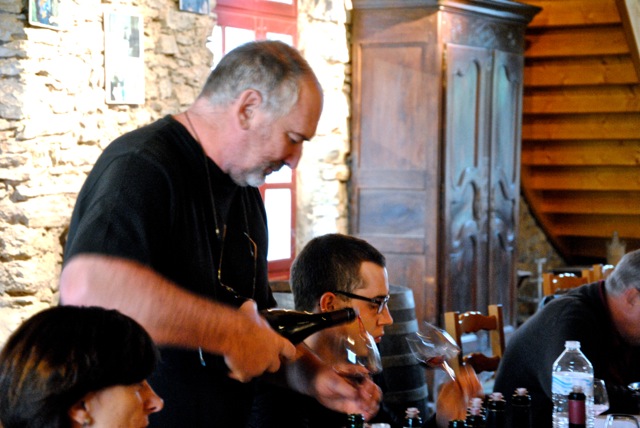
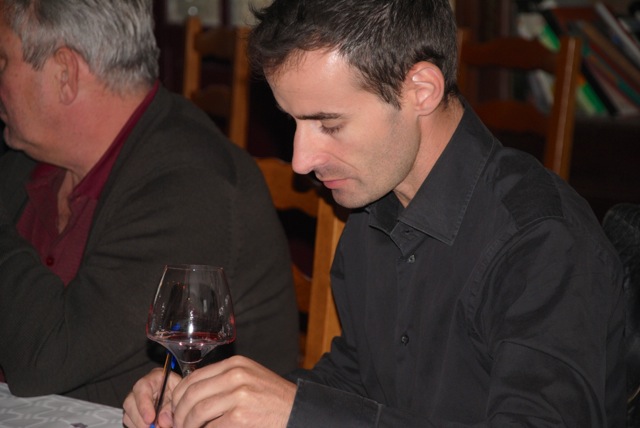
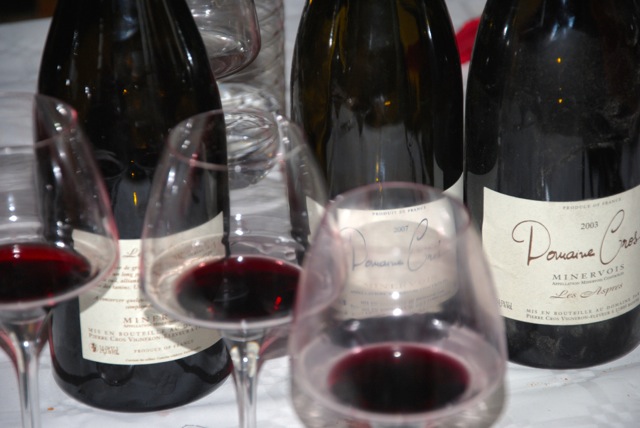
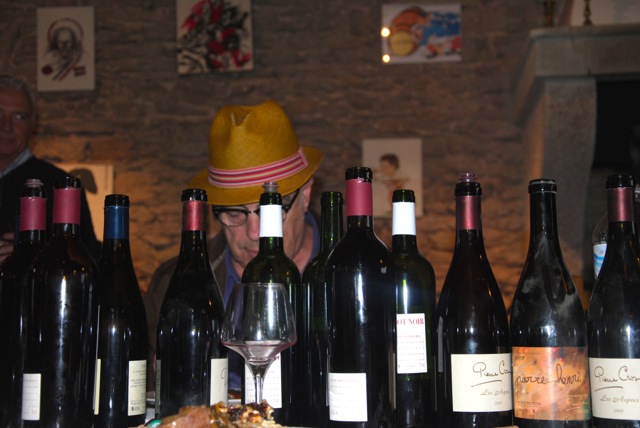
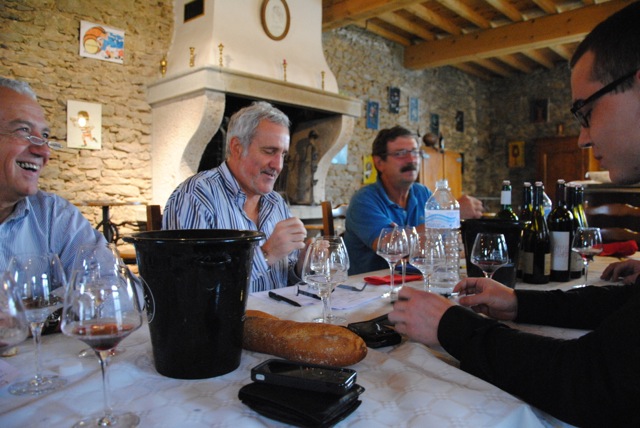
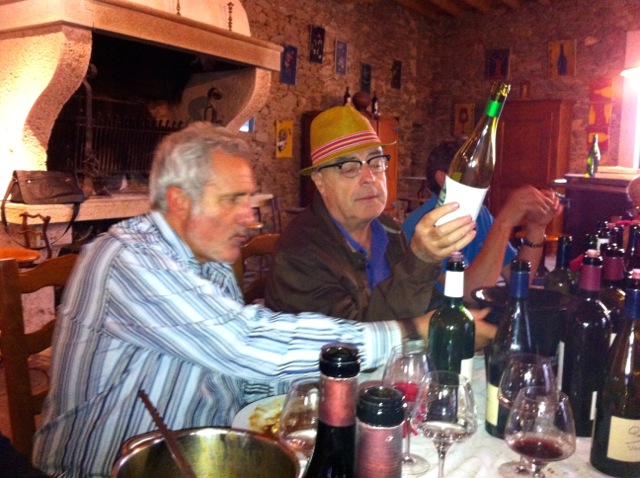
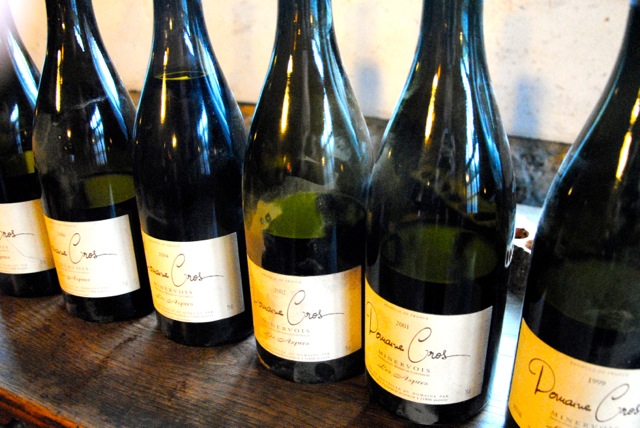
Vertical tasting of “Les Aspres” from 2011 down to 1998...
Vertical tasting of “Les Aspres” from 2011 to 1998...
Seventh „Coup de Cœur“ fort he leading cuvée of the estate. As a “spiritual leader” of the Minervois, Pierre Cros belongs to those wine grower artists, that have found the Holy Grail in their vineyards and share their life’s work with us, by honouring our tables with their Devine brewage.
Pierre Cros Les Aspres - VinParleur
This 2009 provides aromas of black currant, vanilla, blackberry, pepper and cinnamon of exceptional intensity. Smooth and full-bodied, even sensual on the palate, this wine evolves towards an apotheosis of a nearly endless final.





 RSS
RSS